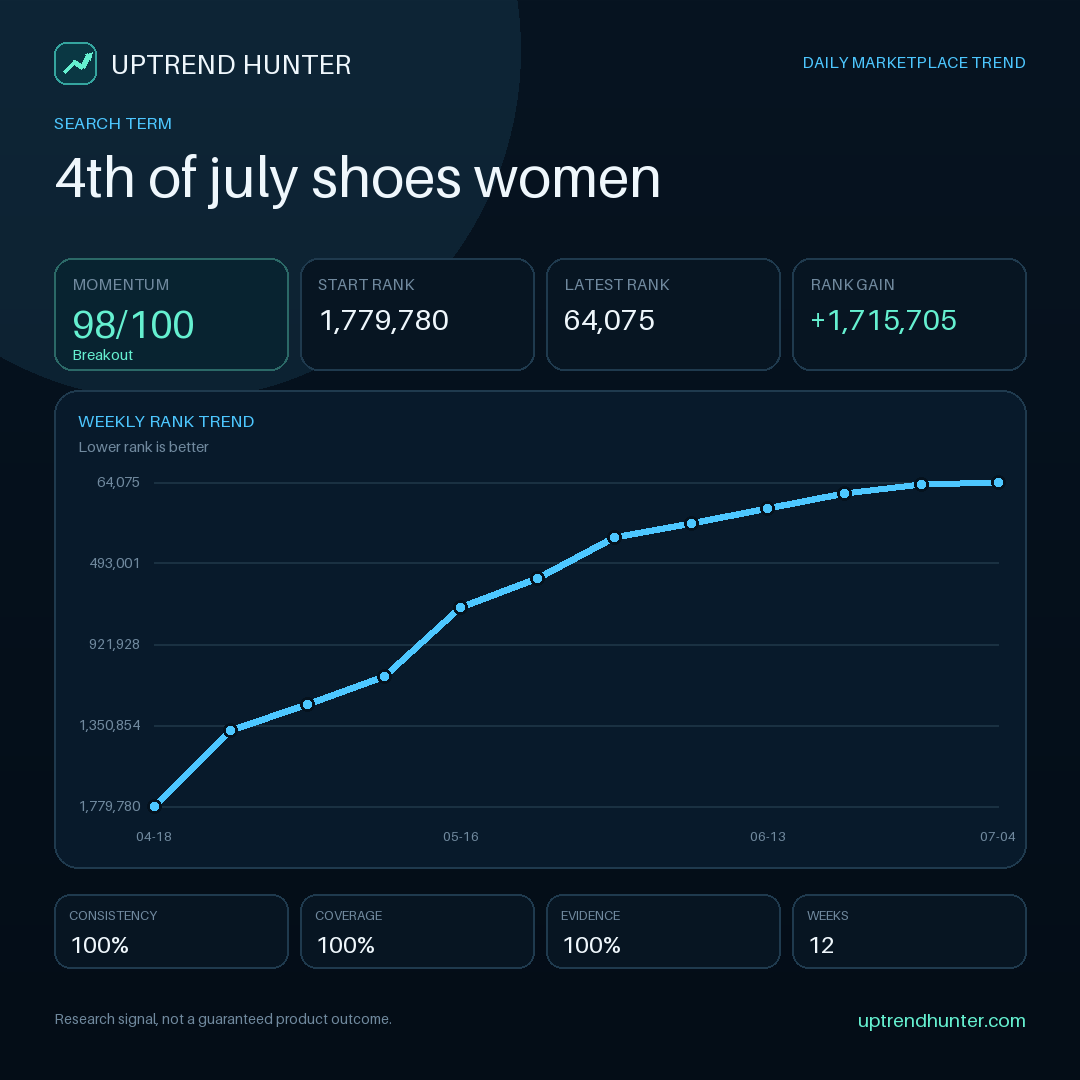
What the 2026 trend data shows
This post-season review examines the 4th of july shoes women Amazon search trend using Search Frequency Rank observations from April 18, 2026, through July 4, 2026. Lower Search Frequency Rank is better, meaning a falling rank indicates stronger relative search prominence within Amazon’s search environment. It does not reveal exact search volume, sales, revenue, conversion, or the number of shoppers behind the term.
The term’s rank improved from 1,779,780 at the start of the observed period to 64,075 at the end, a total improvement of 1,715,705 positions or 96.4%. The series covered 12 weeks and all 11 week-to-week transitions improved. The dataset classifies the pattern as Breakout momentum, with Accelerating movement, High consistency, and Low volatility.
- The observed data ran through July 4, 2026, while this analysis was prepared on July 17, 2026.
- The most recent available observation was 13 days old at the time of analysis.
- Coverage was 100.0% across the observed period, so there were no missing weeks in this series.
The path to stronger relative search prominence
The rise was not limited to a single late spike. The term crossed from a seven-figure rank into a six-figure rank during the observation window, then finished at 64,075. That progression matters because it shows improving relative prominence across the full measured run rather than only at the final point.
Momentum also strengthened toward the end of the series. The recent change was 31.7%, compared with a prior change of 23.1%, supporting the Accelerating label. With 11 improving transitions out of 11 and volatility measured at 9.7%, the observed path was unusually orderly for a holiday-specific query.
- The term reached a rank below 300,000 by June 6, 2026.
- It moved below 100,000 by June 27, 2026.
- It finished below 65,000 on July 4, 2026.
Interpretation for seasonal product researchers
The evidence is consistent with a seasonal query gaining relative Amazon search prominence as Independence Day approached. For researchers, the useful lesson is timing: shoppers appeared to become progressively more focused on this wording across the measured pre-holiday window. The clean progression may help inform when to begin monitoring related footwear, apparel, accessories, and party-oriented search terms in a future cycle.
However, rank movement alone is not a product opportunity or a business case. A phrase can improve because of changing query behavior while still being poorly aligned with available products, difficult to advertise, highly competitive, or too narrow for a seller’s assortment. The trend also cannot establish whether shoppers wanted casual shoes, sandals, sneakers, novelty footwear, matching outfits, or another product format.
- Treat the 96.4% rank improvement as evidence of stronger relative search prominence, not proof of increased search counts.
- Treat Breakout and Accelerating classifications as descriptions of this observed rank pattern, not guarantees for the next holiday cycle.
- Use the full path, including the late-June move below 100,000, as a planning reference rather than as a fixed annual timetable.
Limitations and validation for the next cycle
This signal is no longer a current launch opportunity because the named holiday had already passed when the analysis was conducted on July 17, 2026. In addition, the data ends on July 4, 2026, so it does not show post-holiday demand behavior, product-level performance, or whether interest immediately declined. Search Frequency Rank is a relative metric and can change alongside the broader Amazon query landscape.
For next-cycle planning, begin with a broader keyword map well before the holiday window and track the same core term alongside close variations. Then validate whether the demand language maps to viable products and whether listings can meet shopper expectations. A seasonal decision should combine trend direction with catalog evidence, competitor review, compliance checks, margin modeling, sourcing lead times, and advertising test results.
- Review Amazon search results to identify the product types and price positioning associated with the query.
- Compare related holiday footwear phrases to determine whether this wording is a leading term, a supporting term, or an isolated query.
- Test listing imagery, titles, and campaign structure early enough to learn before the expected seasonal rise, without assuming the 2026 pattern will repeat exactly.
Questions about this topic
What does a lower Amazon Search Frequency Rank mean?
A lower Search Frequency Rank indicates better relative search prominence, but it does not provide an exact count of searches or shoppers.
Was this a stable 2026 seasonal trend?
Within the 12 observed weeks, all 11 transitions improved and volatility was 9.7%, which supports the supplied High consistency and Low volatility classifications.
Should sellers launch women’s 4th of July shoes immediately based on this trend?
No, the holiday had passed by the July 17, 2026 analysis date, so this is best used as a next-cycle research lesson that still requires product, competition, and margin validation.