What the marketplace search data shows
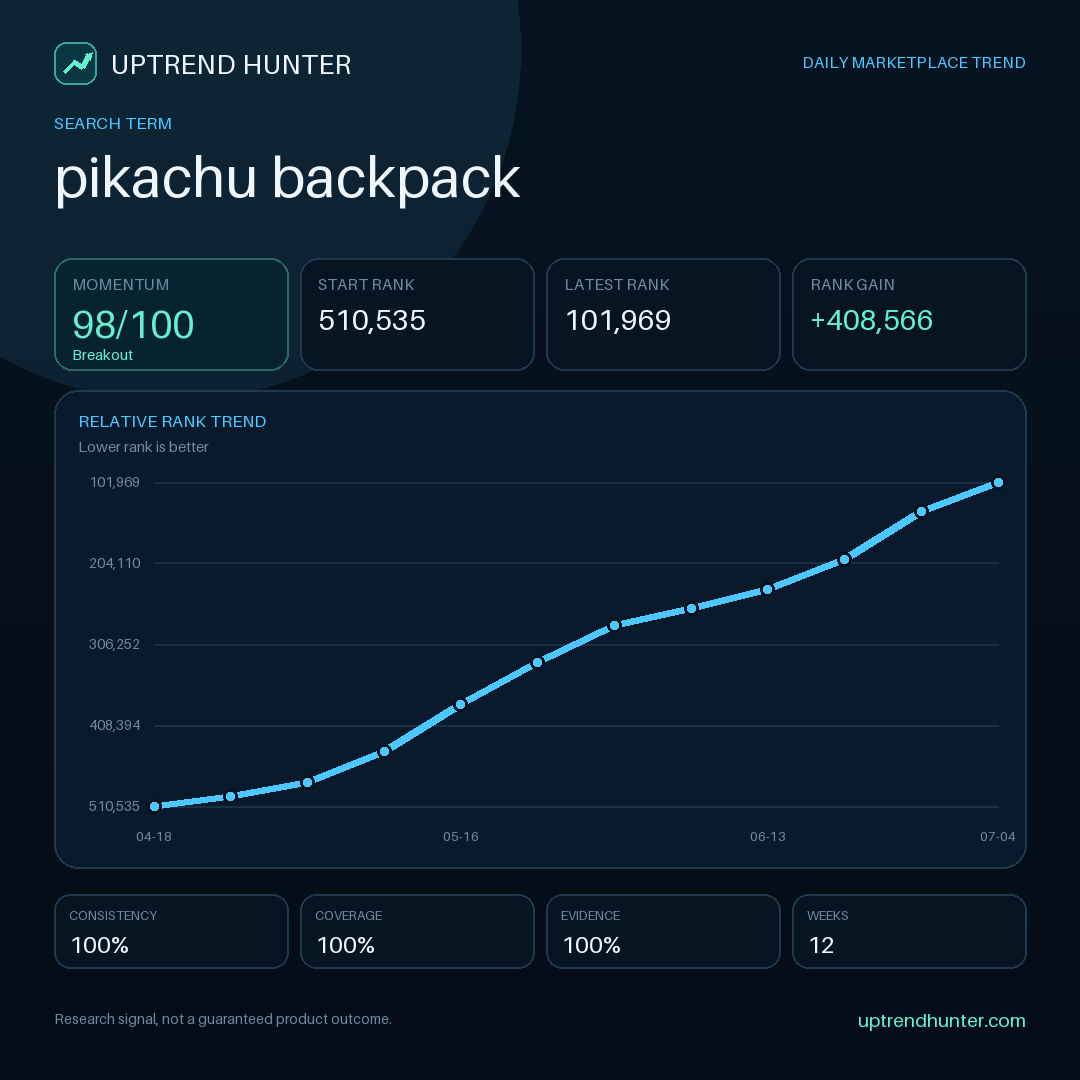
The pikachu backpack marketplace search trend is classified as Breakout and Accelerating in the available 12-week dataset. Relative Search Rank improved from 510,535 on April 18, 2026, to 101,969 on July 4, 2026, a total improvement of 408,566 positions. Because a lower Relative Search Rank is better, this movement indicates substantially stronger relative search prominence over the observed period.
The dataset recorded improvement in all 11 week-to-week transitions, producing 100.0% consistency and 100.0% coverage. Volatility is labeled Low at 8.4%, while the momentum score is 98 and the overall improvement is 80.0%. These are observed ranking characteristics, not estimates of shopper counts, search volume, unit sales, revenue, or future performance.
- The term moved below a Relative Search Rank of 500,000 early in the period.
- It later moved below 300,000 and then below 200,000 before ending at 101,969.
- The most recent change was 24.3%, compared with a prior change of 9.0%, supporting the Accelerating label.
How to interpret the breakout pattern
The evidence supports an interpretation that pikachu backpack gained relative prominence among marketplace searches during the measured window. A steady sequence of improving ranks is more informative than a one-week spike, and the Low volatility label suggests the progression was comparatively stable rather than highly erratic. The stronger recent change also indicates that the rank improvement was not fading at the end of the reported series.
That interpretation should remain narrow. Relative Search Rank compares search prominence rather than revealing the absolute number of searches, and a better rank can occur without proving a proportional increase in shopper interest. The data also cannot show whether searchers found suitable products, whether listings converted, which backpack styles were preferred, or whether the term is commercially viable after advertising, sourcing, fees, and competitive pressure are considered.
Why the signal is still timely, with limits
The data was last updated on July 4, 2026, and this analysis is dated July 18, 2026, making the latest observation 14 days old. That is recent enough for the pattern to be useful as a research lead, especially because the end-of-series rank remained near the strongest point in the supplied history. It is not, however, a real-time reading of current marketplace behavior.
The term is associated with a recognizable character property, which makes rights and listing eligibility an essential part of interpretation rather than an afterthought. Search momentum can attract sellers toward branded demand that they may not be authorized to serve. Product researchers should therefore treat the rank trend as a prompt to investigate compliant, differentiated options, not as permission to source or list merchandise using protected branding or imagery.
- Review current search results to identify whether leading offers are licensed, generic, handmade, used, or otherwise differentiated.
- Check marketplace policies, intellectual-property rights, and supplier documentation before creating a listing or committing inventory.
- Compare the query with adjacent, compliant backpack attributes to determine whether demand may extend beyond the exact branded phrase.
Validation steps for Amazon sellers
Start with a current search-results audit. Examine the visible product formats, price positioning, review strength, fulfillment mix, imagery conventions, and the extent of sponsored placement. The purpose is not to infer exact sales from rank, but to understand what a shopper encounters and whether a compliant offer could solve an unmet need. Pay particular attention to size, comfort, school use, materials, storage layout, and quality cues that may matter in backpack selection.
Next, validate demand and economics using sources available to your business. Check whether the trend remains favorable after July 4, assess related search terms, and inspect historical patterns over a broader period if available. Then model landed cost, referral and fulfillment fees, advertising requirements, return risk, inventory lead time, and realistic conversion assumptions. A small controlled test or a limited inventory commitment can provide operational evidence before a larger purchase order is considered.
- Document the exact customer use case and product specification before contacting suppliers.
- Separate licensed product opportunities from generic designs that avoid protected names, artwork, and confusing similarity.
- Set decision thresholds for margin, compliance, quality, and competitive differentiation before testing.
A practical conclusion for product research
Observed evidence is clear: the term improved in Relative Search Rank across every recorded transition, moved from 510,535 to 101,969, and finished with a 24.3% recent change. Those facts justify monitoring the pikachu backpack marketplace search trend as an unusually strong search-prominence signal within this limited dataset. The Breakout, Accelerating, High consistency, and Low volatility labels are mutually supportive descriptions of that observed path.
The business conclusion is necessarily more restrained. Stronger relative search prominence does not independently demonstrate a sellable opportunity, forecast demand, or guarantee a profitable launch. Sellers should use this finding to prioritize current-result research, compliance review, adjacent-keyword analysis, and unit-economics testing. If those checks confirm a compliant, differentiated offer and acceptable economics, the trend can become one input in a broader product decision.
Questions about this topic
What does a lower Relative Search Rank mean?
A lower Relative Search Rank means the search term has better relative search prominence in the measured marketplace dataset.
Does this trend prove that pikachu backpacks will sell well?
No, rank movement does not reveal exact search volume, sales, revenue, conversion, competition, compliance status, or profitability.
What should sellers check first?
Sellers should first review current search results and intellectual-property requirements, then validate adjacent demand, differentiation, costs, fees, and test economics.